


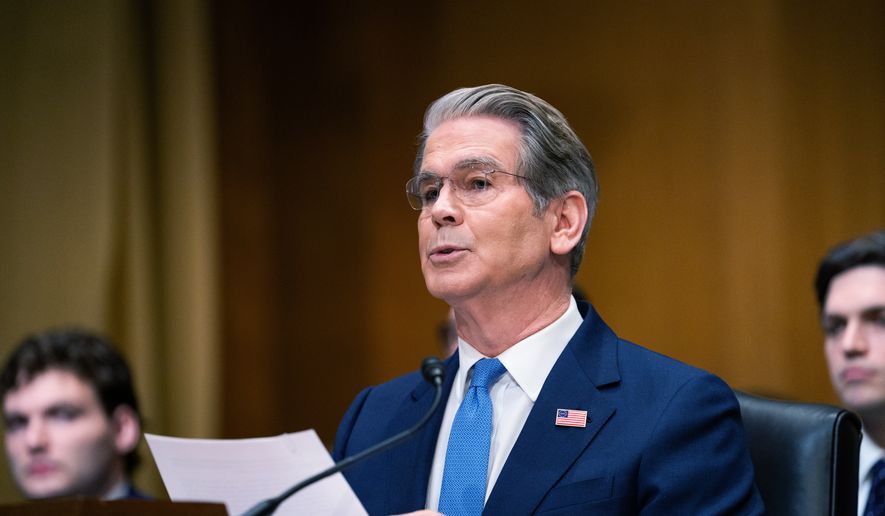

Treasury Secretary Scott Bessent says President Trump plans to drastically dial up financial pressure on Iran as the Middle East conflict reverts to an economic war of wills.
Mr. Bessent has issued a series of new sanctions against Iranian figures and proxies since last year, though his comments suggest a new wave is coming.
“Watch this space for more announcements coming next week because we are going to apply measures like have never been seen in the history of the economic isolation of a country,” Mr. Bessent told Newsmax’s “Rob Schmitt Tonight” on Thursday.
The secretary did not elaborate, but his comments affirm Mr. Trump’s decision to rely on economic pressure instead of an outright bombing campaign against the Islamic regime in Tehran.
Mr. Trump signaled in recent days that he plans to keep a U.S. blockade on Iranian ports and shipping indefinitely.
He is betting that high inflation and other economic strife will force Iran to meet his terms for ending the war and constraining Tehran’s nuclear ambitions.
SEE ALSO: Iran asserts full claim to Strait of Hormuz, calls U.S. war ‘miscalculated’
Mr. Bessent said coming actions “will be a combination of economic isolation like the world has never seen before, and the continued blockade in the Strait of Hormuz that will keep anything from going in or out of the Iranian ports.”
Iranian officials have been defiant in the face of economic threats, saying Mr. Trump “miscalculated” in waging war against their country. Iran says no ships may transit the Strait of Hormuz without its authorization, contradicting Mr. Trump’s claim of U.S. control over the waterway.
Mr. Trump, working with Israel, launched military strikes against Iran on Feb. 28 to prevent it from obtaining a nuclear weapon.
Iran retaliated by closing the strait, an oil choke point, leading to cycles of violence and diplomacy.
The United Arab Emirates said two ships tied to its national oil company, ADNOC, were attacked in the strait Thursday.
The UAE blamed the attacks on Iran, sparking widespread condemnation of Tehran from Arab nations in the region.
Violence in the region has caused global oil and gasoline prices to oscillate.
The average U.S. price of gas stood at $4.08 per gallon on Friday, relatively unchanged from one day prior but a 37% increase from when the war started, according to the AAA motor club.
Contact the author


Please read our comment policy before commenting.